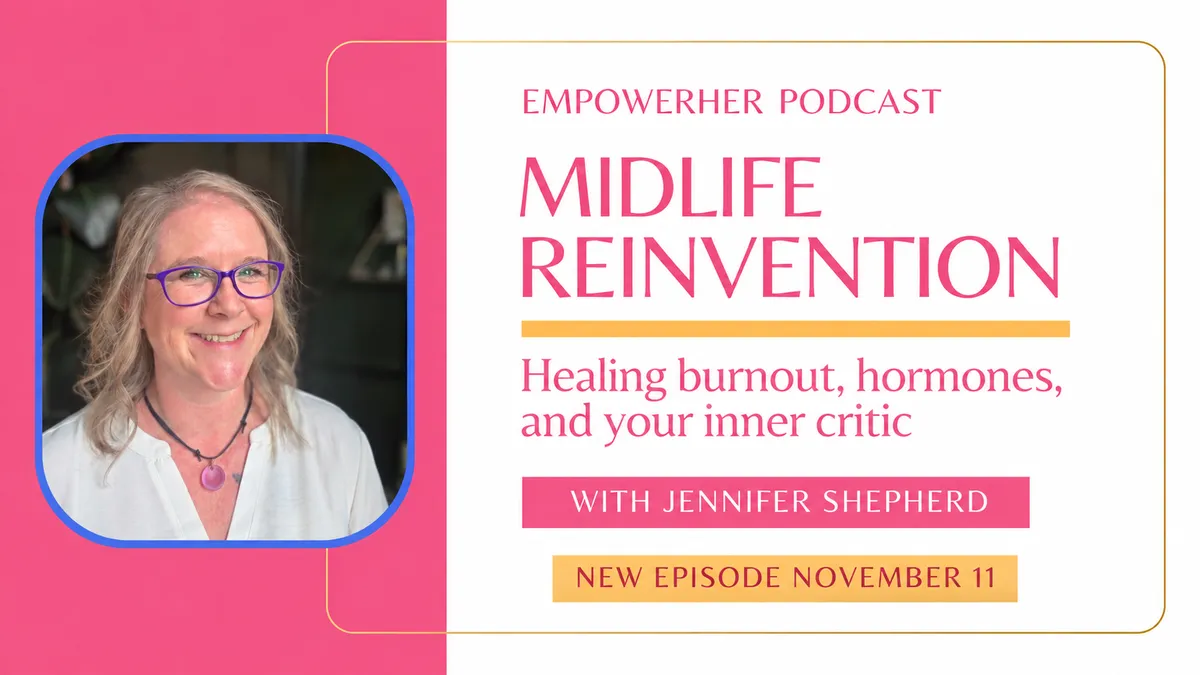
Midlife Reinvention: Healing Burnout, Hormones, and Your Inner Critic
Midlife Reinvention: Healing Burnout, Hormones, and Your Inner Critic
There are seasons when life asks us to slow down and pay attention. We may notice that the routines we once managed easily feel heavier, that our self-talk has grown harsher, or that the way we have been living no longer feels like a fit. Sometimes the invitation to change arrives quietly. Other times, it comes through exhaustion, a health concern, a career transition, or a realization that we have been caring for everyone around us while leaving ourselves out of the picture.
On the upcoming episode of EmpowerHer Podcast, I sit down with Jennifer Shepherd, health coach and founder of Jen’s Whole Health Coaching LLC, for a conversation about midlife reinvention, burnout, hormones, and the inner critic. Jennifer’s story reminds us that reinvention is rarely a single moment when everything suddenly becomes clear. It is often a process of listening, asking new questions, and finding support as we move through change.
Jennifer has spent years working with children and families. She understands how easily people in helping roles can become deeply invested in caring for others. Her own experiences, including going through menopause in her twenties, shaped the way she thinks about women’s well-being and the importance of looking at the whole person.
Our conversation is for the woman who has been pushing through, wondering why she feels depleted, or trying to figure out who she is becoming. It is also for the caregiver, educator, nurse, social worker, parent, or leader who wants to continue showing up for others without losing connection with herself.
Reinvention often begins beneath the surface
We sometimes talk about reinvention as if it happens all at once. We imagine waking up with a new plan, a new sense of confidence, and a clear idea of what comes next. Real life is usually more layered. Change can begin with discomfort, grief, questions, or a feeling that something in our lives needs attention.
In our conversation, we talk about how experiences from the past can continue to shape the way we see ourselves. A decision we regret, a difficult relationship, or a season when we felt unseen may become part of the story we tell about who we are. Over time, that story can feel fixed, even when we have grown beyond the person who first lived it.
Reinvention does not require us to erase our history. We do not have to pretend that painful experiences did not happen or force ourselves to feel grateful for every hard thing. We can acknowledge what happened and still make room for new choices, new meaning, and a different relationship with our past.
That is one of the ideas I keep returning to after this conversation: you are allowed to evolve beyond the version of yourself who first told your story. Your experience remains part of your life, but it does not have to define every chapter that comes after it.
When burnout shows up in everyday life
Burnout does not always look like a dramatic collapse. It can appear in ordinary routines and small changes that are easy to dismiss. We may have trouble sleeping, feel more reactive, struggle to make decisions, or notice that we are operating on autopilot. We may keep telling ourselves that we will rest after one more task, one more deadline, or one more person has what they need.
In the episode, I share a moment when I went to work on a Saturday without realizing what day it was. I had no reason to be in the office, but I was already thinking about being late and sending an apology to my supervisor. It was only after I arrived and found the floor empty that I realized it was Saturday. My mind had been moving so automatically that I had lost track of the day.
That moment made me stop and notice how far I had been pushing myself. I had treated constant motion as normal and rest as something I needed to earn. I know many women who recognize that pattern. We keep going because people are counting on us, because the work matters, or because we worry that slowing down means letting someone down.
Jennifer and I talk about noticing the signals earlier. Burnout can affect many parts of our lives, including how we sleep, how we eat, how we approach movement, and the choices we make. When we are depleted, it can also be easier for the inner critic to take over. We may judge ourselves for feeling tired, then feel worse because we are not doing everything we think we should.
Noticing these patterns is not about blaming ourselves. It is an opportunity to get curious. What has been demanding so much of my energy? What am I carrying that I do not need to carry alone? What would support look like before I reach the point of exhaustion?
You do not have to wait for permission to pause
One of the most practical reminders from Jennifer’s story is that rest does not need to be elaborate to matter. She shared an example of a mother in her Clarity Catalyst group who joined a session from her car because it was the quiet space available to her. Jennifer encouraged her to take that moment.
She also offered a simple idea for a parent who has children in the backseat: pull into a safe place, roll down the windows, and take a few deep breaths. That small pause will not solve every challenge, and it may not be possible in every moment. But it can create a little room to notice how you are doing and respond with care.
Many women wait for someone else to tell them it is okay to stop. We may wait until the work is finished, the house is in order, or everyone else is settled. But the list can keep growing. Sometimes we have to give ourselves permission to pause in the middle of real life, even if the pause is short.
A pause might mean stepping outside for a few minutes, taking a breath before answering a message, asking someone to help with one task, or choosing to rest instead of filling every quiet moment with another responsibility. It might mean noticing that you are overwhelmed and telling someone you trust.
The point is not to create another standard we must meet. Rest is not one more item to do perfectly. It is a way to listen to ourselves and recognize that our needs matter, too.
Caring for the whole woman
Jennifer’s work is informed by her own experience of menopause in her twenties, at a time when she says there was far less open conversation about it. She remembers noticing changes in her body while exercising regularly and trying to understand what was happening. Her experience shaped her interest in looking for underlying factors and asking more complete questions about women’s health.
Today, Jennifer’s whole-woman approach considers how areas such as hormones, sleep, nutrition, gut health, stress, and emotional well-being can interact. Her perspective encourages women to look beyond a single explanation and to seek support when something feels different or concerning.
Women deserve to have their health questions taken seriously. If you are noticing changes in your body, mood, sleep, energy, or menstrual cycle, consider talking with a qualified healthcare professional who can help you understand your individual situation. A coach can support reflection, habits, and personal goals, but coaching is not a substitute for medical care or diagnosis.
Caring for the whole woman also means recognizing that well-being is influenced by more than physical symptoms. Our responsibilities, relationships, work environments, stress levels, and sense of connection can all affect how we experience daily life. We may need more than one kind of support, and asking for it is not a failure.
Quieting the inner critic
We also talk about the way the inner critic can shape our understanding of ourselves. Jennifer shared that feedback could feel personal, even when it was offered with good intentions. Her inner critic could take someone’s words and turn them into a much harsher story.
Many of us know that experience. A brief comment can stay with us for hours. We may replay a conversation and decide we did everything wrong. We may assume that one difficult day says something permanent about our worth or ability.
One shift Jennifer described was learning to get curious instead of immediately judging herself. Curiosity gives us a little space between what happened and the meaning we assign to it. We can ask: What was actually said? What am I adding to the situation? Is there another way to understand this? What would I say to someone I care about if she were in my place?
Getting curious does not mean ignoring feedback or refusing to take responsibility. It means separating useful information from the insults our inner critic may attach to it. We can learn from a moment without turning it into proof that we are not enough.
One word can change where we speak from
Jennifer is a contributing author of The Midlife Advantage. While revisiting a sentence in her chapter, she removed one word: “still.” The original sentence carried the feeling that nobody knew what to do with her. After stepping away and returning to the writing, she recognized that she no longer wanted to carry that particular word into the present.
Editing that one word did not change what she had experienced. It changed the place from which she was telling the story. That distinction is powerful. Sometimes we cannot change what happened, but we can notice how we are holding it now.
We may find ourselves attached to a story because it helped us make sense of a painful time. It may have protected us, explained our choices, or helped us name what we needed. As we grow, we can revisit that story with compassion. We can keep what is true and release what no longer serves us.
This does not need to happen quickly. We do not have to pressure ourselves to forgive, move on, or feel healed on anyone else’s timeline. We can take the time we need and seek support along the way.
Finding a new community through change
Reinvention can also involve leaving behind familiar people and places. Jennifer shared how stepping away from an office community left her feeling unsettled. A doctor encouraged her to find a new tribe, and that advice stayed with her.
A change in work or identity can bring grief alongside possibility. We may miss the daily conversations, the people who understood the job, or the sense of belonging that came from being part of a team. Even when we know a change was needed, we can still feel the loss of what we left.
Finding community does not mean replacing one group overnight. It may begin with one person who understands what you are navigating, a class where you feel welcome, or a conversation with someone whose values align with yours. Your people do not need to be in the same building or even in the same neighborhood. They are the people who make room for who you are becoming.
Connection can help us remember that we do not have to figure everything out alone. It can offer encouragement, perspective, and a place to be honest about the questions we are still carrying.
A few questions to take with you
If you are in a season of change, give yourself time to reflect without judging the answers. You might start with these questions:
Where in my life have I been operating on autopilot?
What signals might be telling me that I need rest, support, or a different approach?
What story about myself am I ready to look at with fresh eyes?
What is one small way I can give myself permission to pause this week?
Who helps me feel supported and understood?
What would it look like to keep the truth of my experience while making room for growth?
You do not need to answer every question today. Choose the one that feels most relevant and sit with it. Sometimes a small moment of honest reflection is the beginning of a meaningful change.
Continue the conversation with Jennifer Shepherd
Jennifer’s story reminds us that reinvention can include health questions, burnout recovery, changing self-talk, and finding community. There is no single path through those experiences. Each woman deserves the space to listen to herself, ask for support, and make choices that fit her life.
Our conversation on EmpowerHer Podcast goes live November 11. We talk about midlife reinvention, early menopause, burnout in helping professions, the inner critic, and what it can mean to evolve beyond an old story.
Listen to the episode: Listen here.
If this conversation resonates with you, share it with someone who may need the reminder that she can pause, seek support, and begin again.